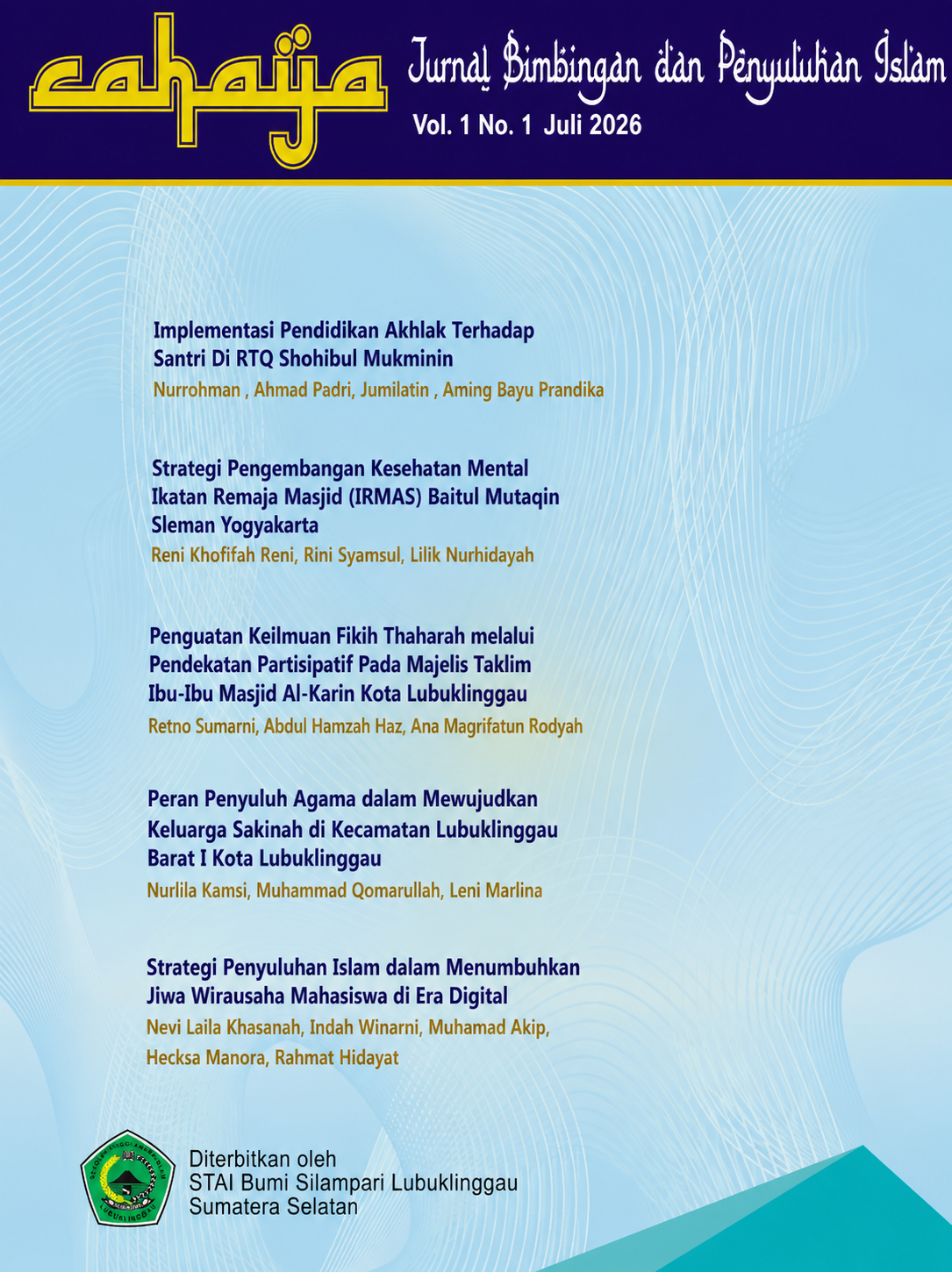
Implementasi Pendidikan Akhlak Terhadap Santri Di RTQ Shohibul Mukminin
DOI:
https://doi.org/10.37092/cahaya.v1i1.1572Keywords:
Implementation, Moral Education, Santri’s, RTQ Shohibul MukmininAbstract
This study aims to analyze the effectiveness of Amal This study aims to analyze the implementation of moral education (pendidikan akhlak) through the Amal Yaumi program and its implications for the daily lives of santri at RTQ (Rumah Tahfidz Al-Qur'an) Shohibul Mukminin. Amal Yaumi is a series of daily activities encompassing mahdhah worship, muamalah, and morals, used as a habituation medium. This research employs a descriptive qualitative approach. Data collection was conducted through participatory observation, in-depth interviews with caregivers, ustadz/ustadzah, and santri, as well as documentation. The results indicate that the implementation of Amal Yaumi is proven effective as a method of moral education in building akhlaq al-karimah, which includes: (1) discipline in worship; (2) honesty and responsibility; (3) social concern and empathy; and (4) adab in daily interactions. The implications of this education manifest in the behavioral changes of santri, both within the RTQ environment and at home, such as politeness, independence in worship, and a decrease in negative behavior. This effectiveness is supported by three pillars: exemplary conduct by ustadz/ustadzah, consistent supervision, and periodic evaluation through the Amal Yaumi control book. This study concludes that structured habituation through Amal Yaumi serves as a transformative method for internalizing Islamic moral values into the santri's character holistically.
Downloads
Published
How to Cite
Issue
Section
License
Copyright (c) 2026 Nurrohman Zulkarnain, Ahmad Padri, Jumilatin, Aming Bayu Prandika

This work is licensed under a Creative Commons Attribution-NonCommercial-NoDerivatives 4.0 International License.