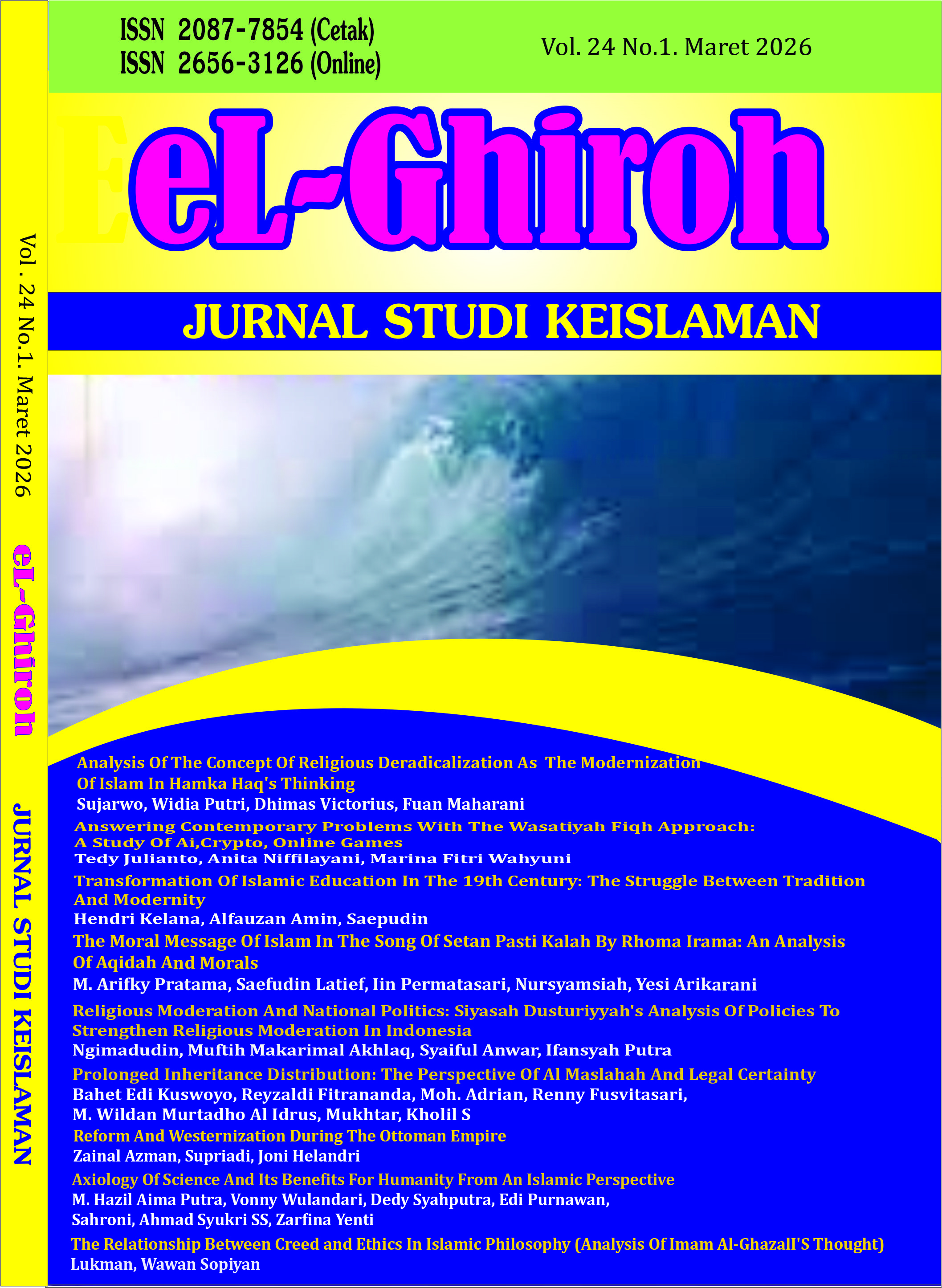
Analysis Of The Concept Of Religious Deradicalization As The Modernization Of Islam In Hamka Haq's Thinking
DOI:
https://doi.org/10.37092/el-ghiroh.v24i1.1346Keywords:
Deradicalization, Modernization, Islam Rahmatan Lil ‘AlaminAbstract
The purpose of this research is to provide understanding tolerance to Muslims related to radical or fundamentalist ideologies so that with this deradicalization can reduce ideologies that can be dangerous for other religious adherents or fellow Muslims themselves. The data analysis technique used is This research uses a descriptive qualitative research method with a type of library research. which is presented in descriptive form which is ultimately expected to be able to provide a comprehensive view of the role of modernization as one of the efforts to overcome radical movements. This research emphasizes the intended data sources are of course related to strengthening religious moderation from the perspective of Islamic religious education to understand the importance of the position of religious deradicalization in strengthening religious moderation literacy. The idea of ??this research is related to religious modernization, namely that Islam must be able to bring peace, justice, and universal benefits and also Islam is not only seen from a normative-theological perspective, but also as a socio-political ethic that guides people in national and state life so that it is hoped that it can make its ideas about religious deradicalization as one of the references in formulating religious education policies so as to offer a holistic and transformative character education model.
Downloads
References
Alfanny, S., Yusuf, K., Himmati, A., & Badri, A. A. 2025. The Concept of Plurality in Indonesia: Examining the Relationship between Islam as Rahmat Li Al-Alamin and Bhinneka Tunggal Ika (Unity in Diversity). The Concept of Plurality in Indonesia: Unity in Diversity. Islamic Studies Journal, 4(1), 23–36.
Alfiyah, E. P. 2023. Religious Moderation Education: A Conceptual Review. Jurnal Pena Kita: Journal of Religion and Religious Affairs, Ministry of Religious Affairs, Tulungagung, 1(1), 1–14.
Alhasbi, F., Fathurrahman, M., & Ahmad, A. A. M. 2024. Religion as a Universal Gift: Understanding the Meaning of Islam as Rahmatan lil ’Alamin. Pawarta: Journal of Communication and Da’wah, 2(2), 113–131. https://doi.org/10.54090/pawarta.718
Angriani, P. 2025. Religious Moderation in the Constitution (A Portrait of Religious Moderation in Lombok Society in Carrying Out the Constitutional Mandate). Journal of Islamic Education Policy, 10(1), 13–19. https://journal.iain-manado.ac.id/index.php/jiep/article/view/3583
Arif, M., & Darwati, Y. 2022. The Existence of Religion in PKB Politics in Nganjuk Regency. Realita: Journal of Islamic Research and Culture, 20(1), 29–54. https://doi.org/10.30762/realita.v20i1.99
Chece Djafar, A. A. 2025. Radicalism in Islam: Tracing the Roots of the Problem and Its Prevention. 1–12.
Ikhwan, M., Azhar, Wahyudi, D., & Alfiyanto, A. 2023. The Role of Islamic Religious Education in Strengthening Religious Moderation in Indonesia. Reality: Journal of Islamic Research and Culture, 21(1), 1–15. https://doi.org/10.30762/realita.v21i1.148
Jalil, A. 2021. Acts of Violence in the Name of Religion. Andragogy: Journal of Educational and Religious Technical Training, 9(2), 220–234. https://doi.org/10.36052/andragogi.v9i2.251
Muhammad Farhan Saidina. 2025. Arba: Journal of Islamic Studies Revitalizing Humanist Islamic Education in Responding to Issues. 1(3), 197–214.
Muhits. 2024. Al Qolam Journal of Da'wah and Community Empowerment. 8(1), 1–13.
Naamy, N., & Hariyanto, I. 2021. Religious Moderation in the Public Sphere in the Shadow of Radicalism. Sophist: Journal of Socio-Political Studies, Islamic Studies, and Interpretation, 3(2), 41–59. https://doi.org/10.20414/sophist.v3i2.51
Pertiwi, T. D., & Herianingrum, S. 2024. Exploring the Concept of Maqasid Sharia: Perspectives on the Thoughts of Islamic Figures. Scientific Journal of Islamic Economics, 10(1), 807. https://doi.org/10.29040/jiei.v10i1.12386
Putra, I. M. D., & Yaqin, A. A. 2023. The Concept of Usul-Furu' in Nusantara Tafsir: Interpretation of QS. Al-Anfal [8]: 65: A Maqasidi Tafsir Perspective. Al-Bayan: Journal of Qur'an and Hadith Sciences, 6(2), 226–242.
Syafiq, M. 2021. The Process of Self-Transformation from a Terrorist to a Peace Activist. Jurnal Ilmiah Psyche, 15(2), 73–92. https://doi.org/10.33557/jpsyche.v15i2.1564
Zakaria, A., Raya, A. T., Saihu, M., & Rokim, S. 2024. A Quranic Perspective on Religious Balance: Assessing Religious Moderation Through Maqashid Sharia. Al-Tadabbur: Journal of Quranic Studies and Tafsir, November, 369–386. https://doi.org/10.30868/at.v9i02.7505
Zuhdi, M. H. 2020. Maqashid Moderation as a Counter-Narrative Model for Religious Extremism. Istinbath, 19(2), 442–469. https://www.istinbath.or.id/index.php/ijhi/article/view/482
Downloads
Published
How to Cite
Issue
Section
License
Copyright (c) 2026 sujarwo sujarwo, Widia Putri, Dhimas Victorius, Fuan Maharani

This work is licensed under a Creative Commons Attribution-NonCommercial-ShareAlike 4.0 International License.